Overview
A lending operations team needed a faster, more reliable way to review customer bank statements as part of their loan origination process. Instead of manually reading multi-page OCR exports and rebuilding summaries in spreadsheets, we implemented an OpenAI-powered financial auditor that ingests raw OCR text from bank statements stored in Google Drive and produces a clean, consolidated monthly summary.
This case study outlines how we orchestrated the workflow with Monday.com, Jotform, Google Drive, and OpenAI to turn messy statement text into decision-ready financial insights.
Goal / Objective
- Automate the review of bank statements as part of a loan origination (LOS) workflow.
- Transform unstructured OCR text from bank statements into structured, analyzable data.
- Identify distinct monthly statement periods across multiple pages and accounts.
- Extract key financial figures from each statement’s Summary section.
- Produce a consolidated report that underwriters and financial analysts can use immediately.
Challenge / Problem
Traditional bank statement review in lending workflows has several pain points:
- Unstructured OCR text: Bank statements are often scanned and converted to text with inconsistent formatting, line breaks, and artifacts.
- Multiple pages and periods: A single upload may contain several months of statements, sometimes across different accounts or banks.
- Manual consolidation: Analysts must scroll through pages of text, locate each “Summary” section, and manually copy figures into spreadsheets.
- Risk of human error: Misreading a number or missing a month can materially impact underwriting decisions.
The client needed a way to reliably interpret this raw OCR text and surface the most important financial figures with minimal human effort.
The Workflow / Solution
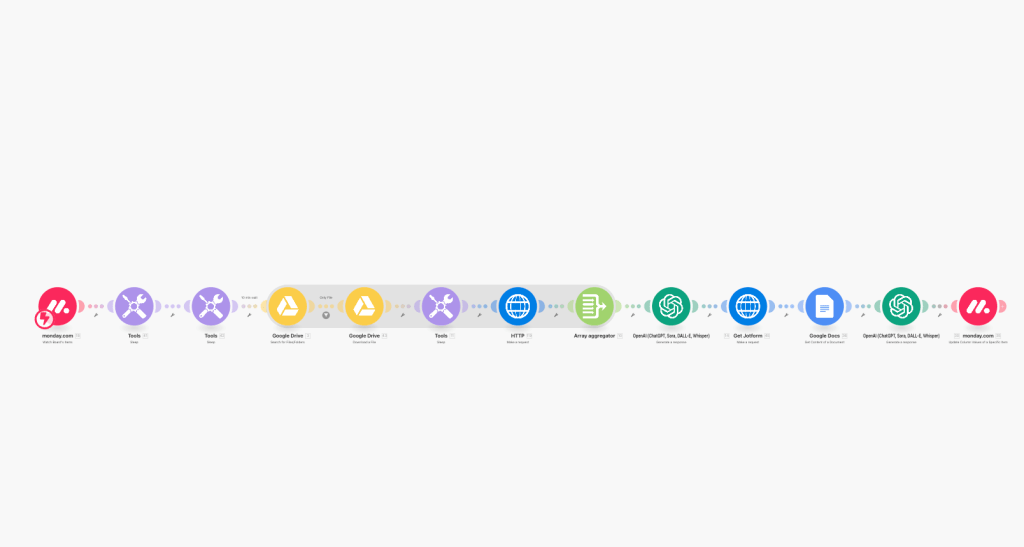
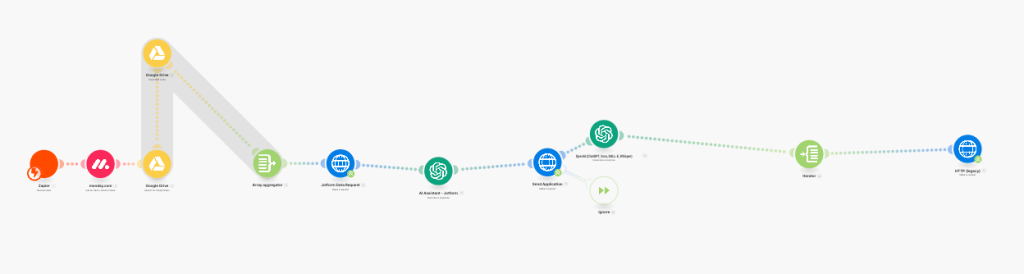
We designed an AI-assisted workflow that uses Monday.com as the orchestration layer, Google Drive as the document store, and OpenAI as the analysis engine.
1. Intake and Task Creation
- Bank statements are uploaded and stored in Google Drive.
- A new item is created in the Portfolio / LOS workflow (either directly in Monday.com or via a Jotform intake form feeding into Monday).
- The task includes links to the relevant Google Drive files and the raw OCR text output from the statement processing step.
2. Triggering the Financial Audit
- When a new “Financial Audit” task is created or moved into the audit stage in Monday.com, an automation kicks off.
- The automation collects the unstructured OCR text for all uploaded bank statement pages associated with that task.
- The text payload is sent to an OpenAI financial auditor prompt tuned specifically for bank statement analysis.
3. AI Analysis of Bank Statements
The OpenAI workflow is instructed to:
- Identify distinct statement periods
- Detect start and end dates for each monthly statement.
- Group pages belonging to the same month or statement period.
- Locate each “Summary” section
- Scan the OCR text for sections labeled “Summary”, “Account Summary”, or similar variants.
- Isolate the lines inside those sections even when formatting is inconsistent.
- Extract key financial figures (when present), such as:
- Opening balance
- Closing balance
- Total deposits / credits
- Total withdrawals / debits
- Fees assessed
- Average balance or minimum balance
- Normalize and validate values
- Standardize currency formats and negative/positive signs.
- Cross-check that opening/closing balances align with total debits and credits when possible.
- Generate a consolidated report
- Output a structured, human-readable summary for each month.
- Provide a consolidated view across all months included in the upload.
4. Consolidated Output Back to the LOS
- The AI’s structured output is returned in a predictable JSON-like structure and formatted into a clear, readable report.
- This report is attached back to the task (in Monday.com and/or ClickUp) as:
- A formatted summary section in the task, and/or
- A linked document that underwriters can reference.
- Optional flags or notes are added for:
- Missing or inconsistent months.
- Large swings in balances or unusual transaction patterns.
- Any parsing ambiguities that may require human review.
Results / Impact
While this implementation is primarily focused on workflow and data quality rather than marketing metrics, the solution is designed to deliver:
- Dramatically reduced manual review time: Analysts receive a ready-made monthly breakdown instead of scrolling through raw OCR pages.
- Higher consistency and fewer errors: The same extraction logic is applied every time, reducing the chance of missed months or mis-keyed values.
- Faster underwriting decisions: With clean monthly summaries, lending or risk teams can focus on judgment calls rather than transcription.
- Scalability: The pipeline can handle many concurrent statement reviews without requiring additional headcount.
Tools Used
- Monday.com – Orchestrates the LOS workflow, tracks each audit request, and stores AI outputs alongside tasks.
- Jotform – (Optional) Used to collect client inputs or upload instructions that feed into Monday.com.
- Google Drive – Secure storage for uploaded bank statement files and OCR outputs.
- OpenAI – Core financial auditor engine that interprets OCR text, extracts figures, and builds the consolidated report.
- Make.com – Automates integrations and workflows between tools, enhancing process efficiency.
 BAEZ TECH SOLUTIONS
Leave a comment